Continental Europe
The contiguous mainland of Europe, excluding its surrounding islands.

via Wikipedia: Europe · see source
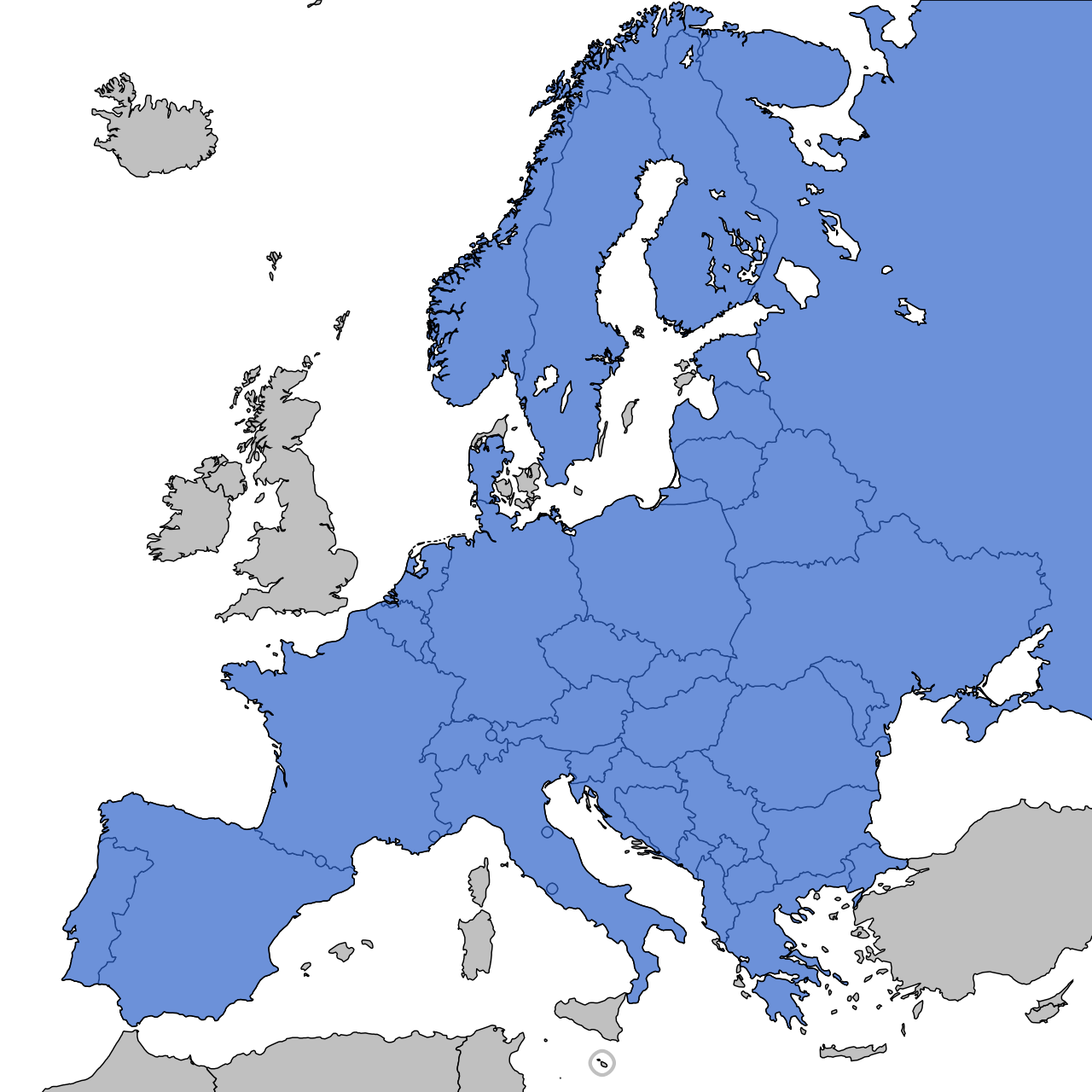
Continental Europe, also known as mainland Europe, is the contiguous mainland of the European landmass, excluding its surrounding islands. It is a geographic and cultural concept that has been used historically as a basis for European integration and remains a common reference point for distinguishing the mainland from islands such as Great Britain, Ireland, and the Nordic archipelago.
- Definition
- Contiguous mainland of Europe, excluding surrounding islands
- Common alternative name
- The Continent
- Largest excluded island
- Great Britain
Lore & Background
The source does not mention the Carolingian Empire or its territory. The most common definition of mainland Europe excludes the Greek islands, Cyprus, Malta, Sicily, Sardinia, Corsica, the Balearic Islands, Great Britain and Ireland, Novaya Zemlya, the Nordic archipelago, and nearby oceanic islands such as the Canary Islands, Madeira, the Azores, Iceland, the Faroe Islands, and Svalbard. The Scandinavian Peninsula is sometimes also excluded because de facto connections to the rest of the continent were historically across the Baltic Sea or North Sea rather than via the lengthy northern land route.
Reader's Guide
The concept of Continental Europe has shaped political, cultural, and economic distinctions, particularly between island nations and the mainland. In Great Britain and Ireland, 'the Continent' is commonly used to refer to mainland Europe, and the word 'Europe' itself is often used to mean continental Europe. The adjective 'continental' describes social practices or fashion from continental Europe, such as breakfast, topless sunbathing, and long-range driving. Differences in electrical plugs, left-hand traffic, and the continued use of imperial units in the UK have reinforced the idea of separation. In Scandinavia, the term 'Kontinenten' refers to continental Europe excluding Sweden, Norway, and Finland, though Denmark is included. From the perspective of island residents, 'the Continent' may also refer to the continental portion of their own country, such as continental France (l'Hexagone), continental Italy (lo Stivale), or peninsular Spain.
Did You Know?
- In Scandinavia, the term 'Kontinenten' refers to continental Europe excluding Sweden, Norway, and Finland, though Denmark is included.
- Malta was considered an island of North-western Africa for centuries, but now it is considered to be part of Europe.
- Cyprus is closest to Anatolia (or Asia Minor), but is considered part of Europe politically and it is a member state of the EU.
Origins & Intellectual Evolution
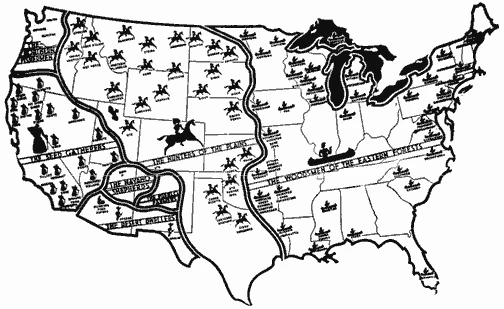
The concept of a cultural area traces its roots to the late nineteenth century, when museum curators and ethnologists needed a practical framework for organizing their exhibits. This early taxonomy-driven approach laid the groundwork for what would become a central idea in cultural anthropology. American scholars Clark Wissler and Alfred Kroeber later refined the notion, arguing that cultural areas reflected deep, longstanding divisions among human communities. While this formulation has drawn criticism for its arbitrariness, the practice of grouping communities into cultural areas has persisted across the social sciences. In the realm of cultural geography, Carl O. Sauer and the Berkeley School introduced a distinctive perspective: culture as an active agent shaping a natural environment into a cultural landscape. Sauer's deterministic framing was subsequently challenged by Yi-Fu Tuan and others, who advocated for approaches that honored subjective, phenomenological experience. This revision gave rise to what is now called humanistic geography, a shift scholars refer to as the cultural turn.
Typology & Classification Systems
Scholars have developed multiple vocabularies for describing how cultural areas are structured. Allen Noble catalogued key terms: Carl Sauer's cultural hearth, Donald Meinig's cultural core (applied to Mormon culture in 1970), and Fred Kniffen's and Henry Glassie's source area for architectural traditions such as house and barn types. Glassie extended Meinig's framework by distinguishing a domain, where a culture is dominant, from a sphere, where influence extends but does not dominate. These spheres can overlap or nest within larger macrocultures, creating concentric layers. A separate typology divides cultural areas into three categories: formal regions, defined by cultural homogeneity across a contiguous area; functional regions, united by shared political, social, or cultural roles; and perceptual or vernacular regions, grounded in how people themselves perceive space. A vivid example is India's Braj region, which coheres as a spatial whole through shared religious and cultural associations rather than any administrative boundary.
Cultural Boundaries in the European Context
A cultural boundary marks the geographic divide between two identifiable ethnic or ethnolinguistic cultures. Because language is a cornerstone of any society's culture, a language border inherently functions as a cultural border, yet it can also split subgroups within the same ethnolinguistic community along subtler lines. In German-speaking Switzerland, the Brünig-Napf-Reuss line separates distinct regional identities. Germany's Weißwurstäquator and the Grote rivieren boundary between Dutch and Flemish culture illustrate how even within a single nation, cultural borders carry deep meaning. On a grander historical scale, Western Europe is divided between Latin Europe, where the Roman Empire's legacy remained dominant, and Germanic Europe, where Roman influence was significantly blended with Germanic traditions. In the Balkans, the Jireček Line separates zones of dominant Latin (Western Roman) influence from those shaped by Greek (Eastern Roman) heritage. At the continental level, such macro-cultures are sometimes called worlds, spheres, or civilizations, as in the Islamic world.
Global Scope & Contemporary Relevance
The concept of cultural areas extends far beyond any single continent. Broad dichotomies like the East–West divide, contrasting Western civilization with the Orient, and the North–South socio-economic split frame global discourse. At finer geographic scales, the concept organizes regions from the Maghreb and Mesoamerica to Melanesia, Micronesia, and Polynesia, from the Iberian Peninsula to the Sinosphere, the Indian subcontinent, and the Levant. Language families offer another organizing principle: the Anglophone world, the Francophonie, Catalan-speaking countries, Celtic Europe, and the German-speaking space in Europe all function as cultural areas defined by shared linguistic heritage. Indigenous groupings, such as the Aboriginal Australian cultural blocs first described by Ronald Berndt in 1959, demonstrate the concept's applicability to non-state societies. Today, as social scientists intensify research into cultural globalization, the definition and practical utility of cultural areas are experiencing a renewed wave of theoretical and applied interest.
Gallery
More in Regions & Cultural Spheres 1-24
Related in Regions & Cultural Spheres
Links follow this subject's own source article.
Elsewhere in the Regions & Cultural Spheres universe
Spotted an error? Know more?
This is a living reference — every entry is fact-audited, and reader corrections feed straight into our audit queue. Suggest an edit · See this site's audit record