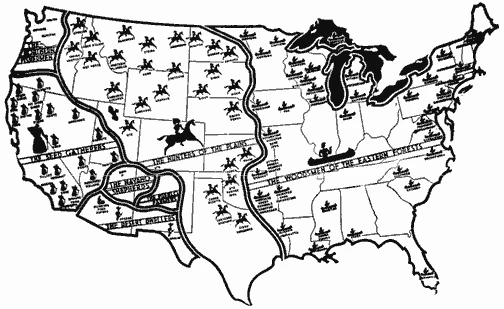
Bioregionalism
Philosophy organizing society around naturally defined bioregions.

Bioregionalism is a philosophy that proposes organizing political, cultural, and economic systems around naturally defined areas called bioregions, which are based on watershed boundaries, soil, terrain, and other physical and environmental features. It emphasizes local populations, knowledge, and solutions, and goes beyond national boundaries, viewing humans as an integral part of nature.
- field
- Environmental philosophy
- known_for
- Organizing human systems around bioregions defined by watersheds and natural features
- origin
- Western coast of North America, 1970s
- key_proponents
- Allen Van Newkirk, Peter Berg, Raymond F. Dasmann, Kirkpatrick Sale, David Haenke
Lore & Background
Bioregionalism emerged in the 1970s, developing primarily along the western coast of North America from a broad coalition of poets, artists, writers, community leaders, back-to-the-landers, and the Digger movement from the late 1960s Beat Scene in San Francisco. It arose as a counter to the mainstream environmental movement, which many felt was reactionary and negative, envisioning a positive, place-based alternative to capitalist or nation-state frameworks. The movement grew from relationships with the civil rights movement, the American Indian Movement, and efforts to reclaim languages, territories, and maps, as well as from the anti-war, anti-nuclear, and Digger movements, and increasing awareness of ecological pollution. Allen Van Newkirk, a Canadian poet and biogeographer, coined the term 'bioregion' as it relates to bioregionalism and founded the Institute for Bioregional Research. Berg defined a bioregion as a geographical area with coherent and interconnected plant and animal communities and other natural characteristics, often defined by a watershed, plus the cultural values humans have developed for living in harmony with these systems. Bioregional mapping is a participatory approach to cartography that focuses on mapping natural, ecological, and human realities within a bioregion, highlighting interconnectedness and integrating ecological data with cultural and historical insights. This practice grew largely from the Tsleil-Waututh First Nation, Nisga'a, Tsilhqotʼin, and Wetʼsuwetʼen First Nations, who used bioregional mapping to create some of the first bioregional atlases as part of court cases to defend their sovereignty in the 1980s and 1990s, such as Tsilhqotʼin Nation v British Columbia.
Reader's Guide
Bioregionalism's significance lies in its challenge to conventional political and economic boundaries, proposing instead that human systems be aligned with natural features like watersheds and ecosystems. It differs from 20th-century environmentalism by being proactive rather than protest-based, viewing humanity and its culture as part of nature and focusing on building a positive, sustainable relationship with both sociological and ecological environments. The philosophy opposes homogeneous economy and consumer culture, seeking to highlight unique ecology, encourage local food and materials, cultivate native plants, and promote sustainability in harmony with the bioregion. Its legacy includes influencing place-based thinking and decolonization efforts, as bioregional mapping has been used by Indigenous nations to assert sovereignty. The concept of bioregions, while distinct from scientifically based ecoregions, incorporates humans and is informed by ecology, geology, and biology, effectively functioning as kincentric ecology. Examples of bioregions include Cascadia, which crosses national boundaries, and the Ozarks, which overlaps state lines. The movement continues through organizations like the Planet Drum foundation and through maps such as David McClosky's map of Cascadia.
Did You Know?
- Bioregional mapping grew largely from the Tsleil-Waututh, Nisga'a, Tsilhqotʼin, and Wetʼsuwetʼen First Nations, who used it in court cases to defend sovereignty in the 1980s and 1990s.
- Bioregions are not synonymous with ecoregions; bioregions are watershed-focused and factor in humans, while ecoregions are scientifically based and focused on ecology.
Frequently Asked Questions
What is Bioregionalism?
Bioregionalism is an environmental philosophy that argues political, cultural, and economic structures should be organized around naturally defined areas—bioregions—shaped by watersheds, soil, and terrain rather than by arbitrary state lines. It treats humans as embedded participants in ecosystems rather than separate from them.
Where and when did Bioregionalism originate?
The movement took shape on the western coast of North America during the 1970s, growing out of a broader counter-cultural push to reconnect communities with their local landscapes.
What does Bioregionalism actually propose in practice?
It calls for communities to draw on local ecological knowledge and develop solutions tailored to their specific watershed or terrain, deliberately crossing national borders when those borders ignore natural boundaries. In short, it reorients governance and culture around the physical environment people actually live in.
Why is Bioregionalism considered significant in environmental thought?
It offers a concrete alternative to the nation-state model by grounding political and economic identity in ecological reality, making it one of the earliest frameworks to explicitly tie human self-governance to watershed and landscape boundaries.
More in Regions & Cultural Spheres 25-29
Elsewhere in the Regions & Cultural Spheres universe
Spotted an error? Know more?
This is a living reference — every entry is fact-audited, and reader corrections feed straight into our audit queue. Suggest an edit · See this site's audit record