Australia (continent)
Smallest continent, located in Oceania, comprising Australia, New Guinea, and Tasmania.

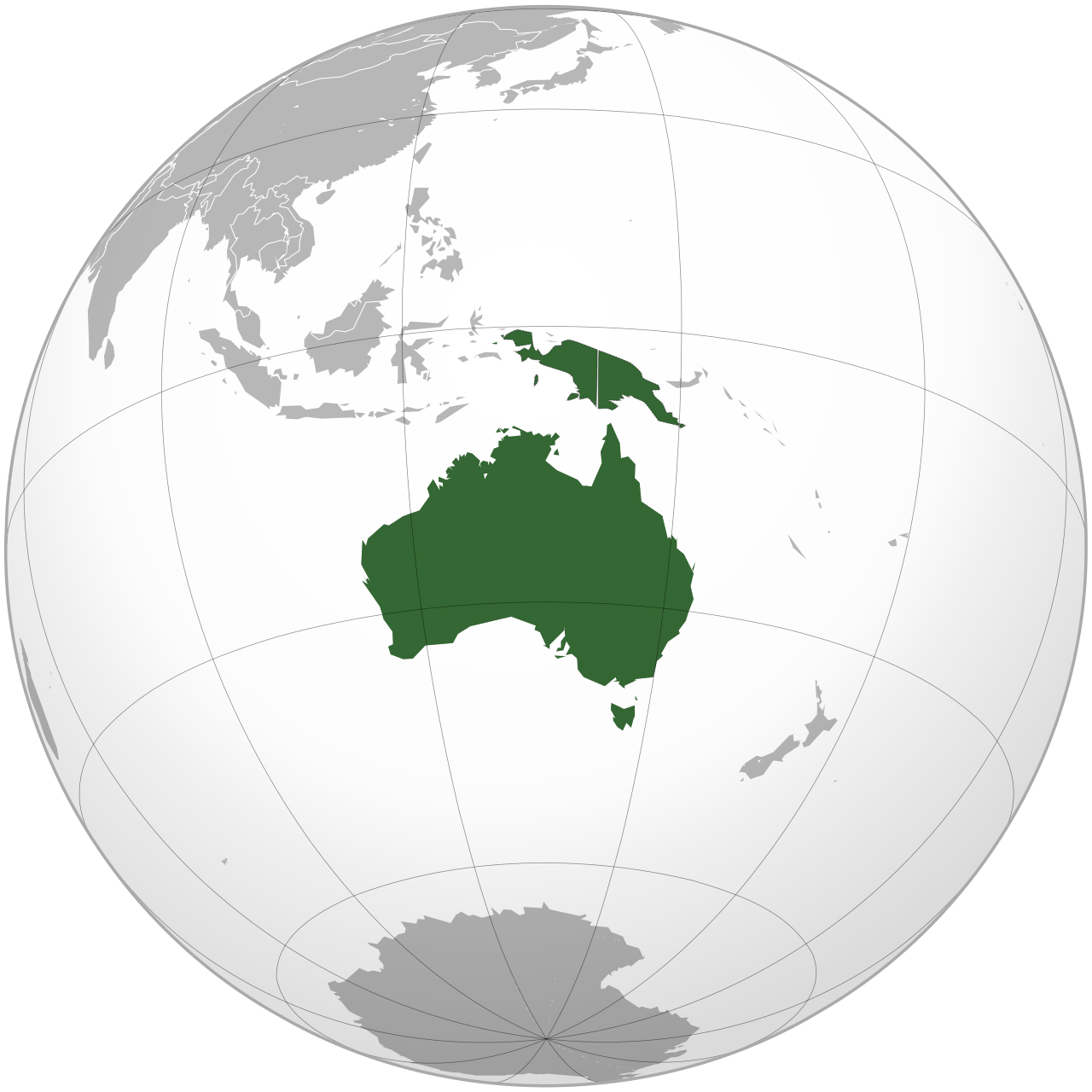
Australia_(orthographic_projection).svg : Ssolbergj derivative work (colouring i · CC BY-SA 3.0
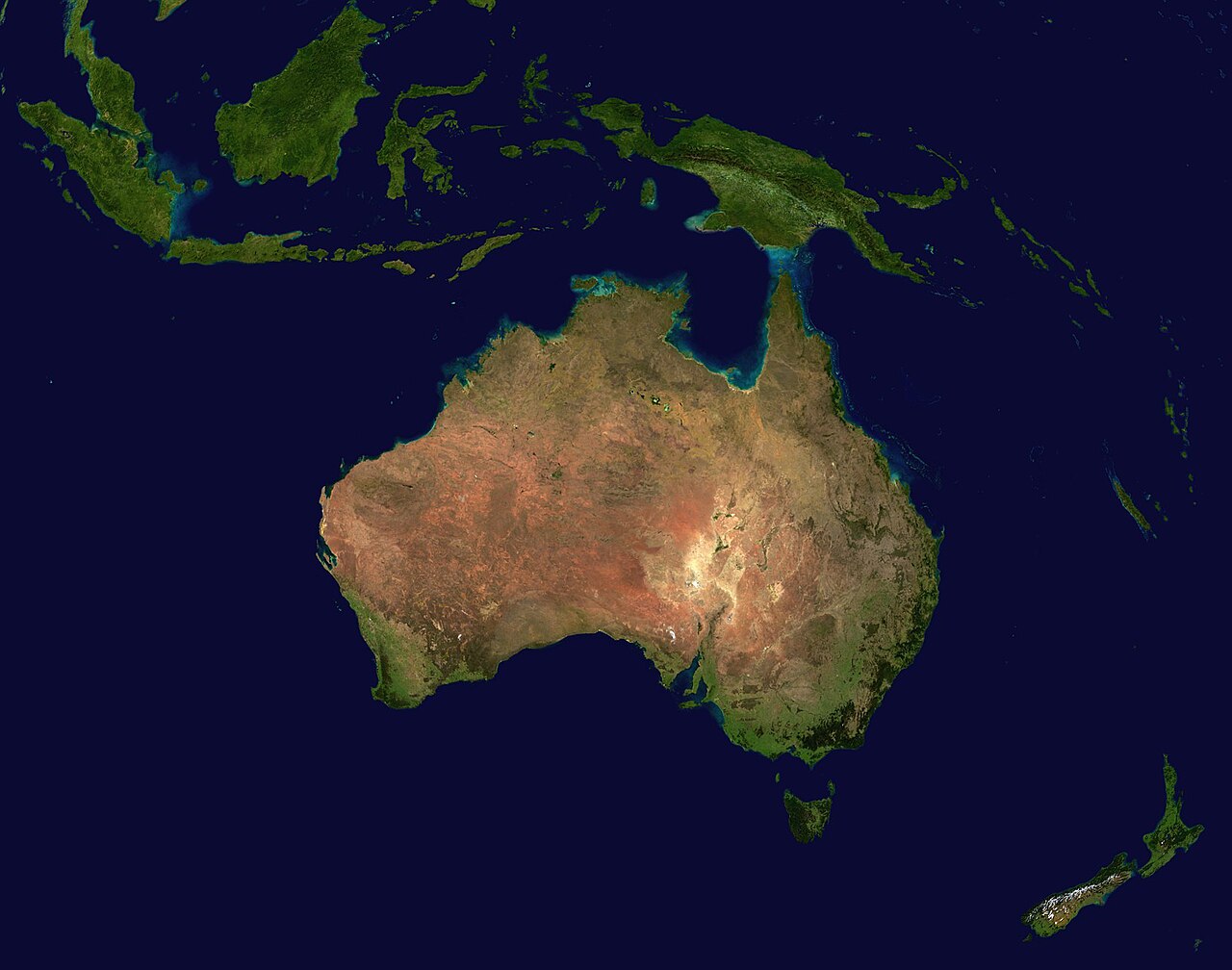
The continent of Australia, sometimes known in technical contexts as Sahul, Australia-New Guinea, Australinea, or Meganesia, is located within the Southern and Eastern hemispheres, near Maritime Southeast Asia. It is the smallest of the seven traditional continents, comprising mainland Australia, Tasmania, the island of New Guinea, the Aru Islands, the Ashmore and Cartier Islands, most of the Coral Sea Islands, and other nearby islands. Its significance lies in its unique geological history, its role as a distinct landmass in the region of Oceania, and its inclusion in various continental models worldwide.
Lore & Background
The continent includes a continental shelf overlain by shallow seas—the Arafura Sea and Torres Strait between mainland Australia and New Guinea, and Bass Strait between mainland Australia and Tasmania. The name 'Sahul' derives from the Sahul Shelf, part of the continent's continental shelf.
Reader's Guide
The continent of Australia is significant as the smallest of the seven traditional continents, with a total land area of 8.56 million square kilometres. Its geological history, particularly the Pleistocene landmass of Sahul, illustrates how sea-level changes shaped its current configuration. The continent is home to the country of Australia, which is highly urbanized and has the world's 12th-largest economy, as well as Papua New Guinea, one of the most culturally and linguistically diverse countries, and Western New Guinea, which contains an estimated 44 uncontacted tribal groups. The term 'Oceania' is used by the United Nations as one of the world's five major continental divisions, encompassing the Australian continent, Zealandia, and various Pacific islands. However, definitions vary: some countries treat Oceania as a continent, while others consider Australia itself a continent. The continent's role in global geography and its unique biodiversity and human cultures underscore its importance.
Did You Know?
- The continent is sometimes called Sahul, Australinea, or Meganesia to distinguish it from the country of Australia.
- Papua New Guinea, within the continent, is one of the most culturally and linguistically diverse countries in the world.
- The UN definition of Oceania is not a single authoritative list; it is a statistical region that can vary by context, and it does not formally exclude or include specific countries in a universally fixed way.
The Cultural Bloc Framework
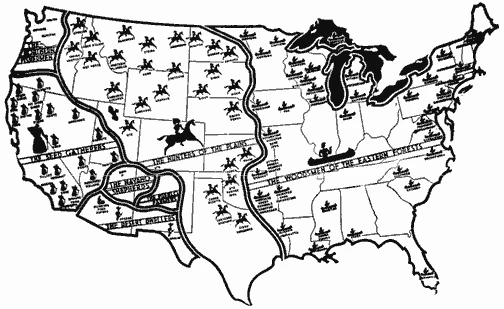
The concept of a cultural bloc was specifically developed by anthropologists to describe groups of Aboriginal peoples in Australia who share cultural and linguistic similarities. Ronald Berndt is credited with first coining the term in 1959, applying it to what became known as the Western Desert cultural bloc. This grouping encompasses peoples in central Australia whose languages collectively comprise around forty distinct dialects. The term sits within a broader typological vocabulary that includes 'cultural hearth' (associated with Carl Sauer), 'cultural core' (Donald W. Meinig, 1970), and 'source area' (Fred Kniffen, 1965; Henry Glassie, 1968). Outside a core area, Glassie employed the terms 'domain' for a dominant region and 'sphere' for an area that is influenced but not dominant. These overlapping and sometimes concentric structures of influence allow scholars to map how macrocultures encompass smaller local cultures across the Australian landscape.
Mapping the Continent's Cultural Regions
Across the Australian continent, several distinct cultural blocs have been identified by researchers. In the south-west, the Noongar people form a recognized cultural bloc. Moving to the east coast, the Bundjalung people occupy a bloc spanning northern New South Wales and southern Queensland. In the far north, the Arnhem Land region of the Northern Territory is home to both the Kuninjku/Bininj Kunwok bloc and the Yolngu cultural bloc. These groupings illustrate how specific cultures often extend beyond the borders of a single nation state or smaller administrative subdivisions. The boundaries between these blocs are not always fixed; different boundaries may be drawn depending on the particular aspect of interest, whether that be religion and folklore, dress, architecture, or language. The concept of a culture area—where a geographic region is characterized by shared elements of environment and culture—provides the theoretical scaffolding for understanding how these diverse Aboriginal groups relate to their specific territories.
Language as Cultural Boundary
A language border is necessarily also a cultural border, since language constitutes a significant component of any society's culture. This principle is particularly evident in the Australian context, where Aboriginal Australian languages exist in numerous sub-groups, each associated with particular territories and ethnolinguistic communities. The Western Desert cultural bloc, for instance, is defined in part by its approximately forty dialects, which together form a complex linguistic system tied to the central Australian landscape. In broader ethnological terms, a cultural boundary marks a geographical division between two identifiable ethnic or ethnolinguistic cultures. While a language border always implies a cultural one, it can also divide subgroups within the same ethnolinguistic group along more subtle criteria. In the Australian context, these boundaries between cultural blocs—whether between the Noongar, the Bundjalung, or the Yolngu—reflect deep historical divisions that predate modern political boundaries and represent longstanding cultural distinctions among the continent's Aboriginal peoples.
Australasia in the Global Cultural Map
Within the broader taxonomy of cultural areas, Australasia occupies a recognized position as a geographic area alongside the Pacific island groupings of Melanesia, Micronesia, and Polynesia. The concept of culture areas, which originated with museum curators and ethnologists in the late 1800s as a means of arranging exhibits, was further developed by American anthropologists Clark Wissler and Alfred Kroeber, who proposed that cultural areas represent longstanding cultural divisions. Cultural geography, associated with the Berkeley School and Carl O. Sauer, viewed culture as an agent within a natural area that produces the cultural landscape. While Sauer's deterministic approach was later critiqued, geographer Yi-Fu Tuan and others introduced phenomenological experience into the framework, a revision known as humanistic geography or the 'cultural turn.' The definition of culture areas is experiencing renewed practical and theoretical interest as social scientists investigate processes of cultural globalization, providing fresh lenses through which to examine the cultural geography of Australasia and its surrounding Pacific regions.
Gallery
More in Regions & Cultural Spheres 1-24
Elsewhere in the Regions & Cultural Spheres universe
Spotted an error? Know more?
This is a living reference — every entry is fact-audited, and reader corrections feed straight into our audit queue. Suggest an edit · See this site's audit record