Arab world
A region of 22 states united by Arabic language and culture.

Qbox673 · CC BY-SA 4.0
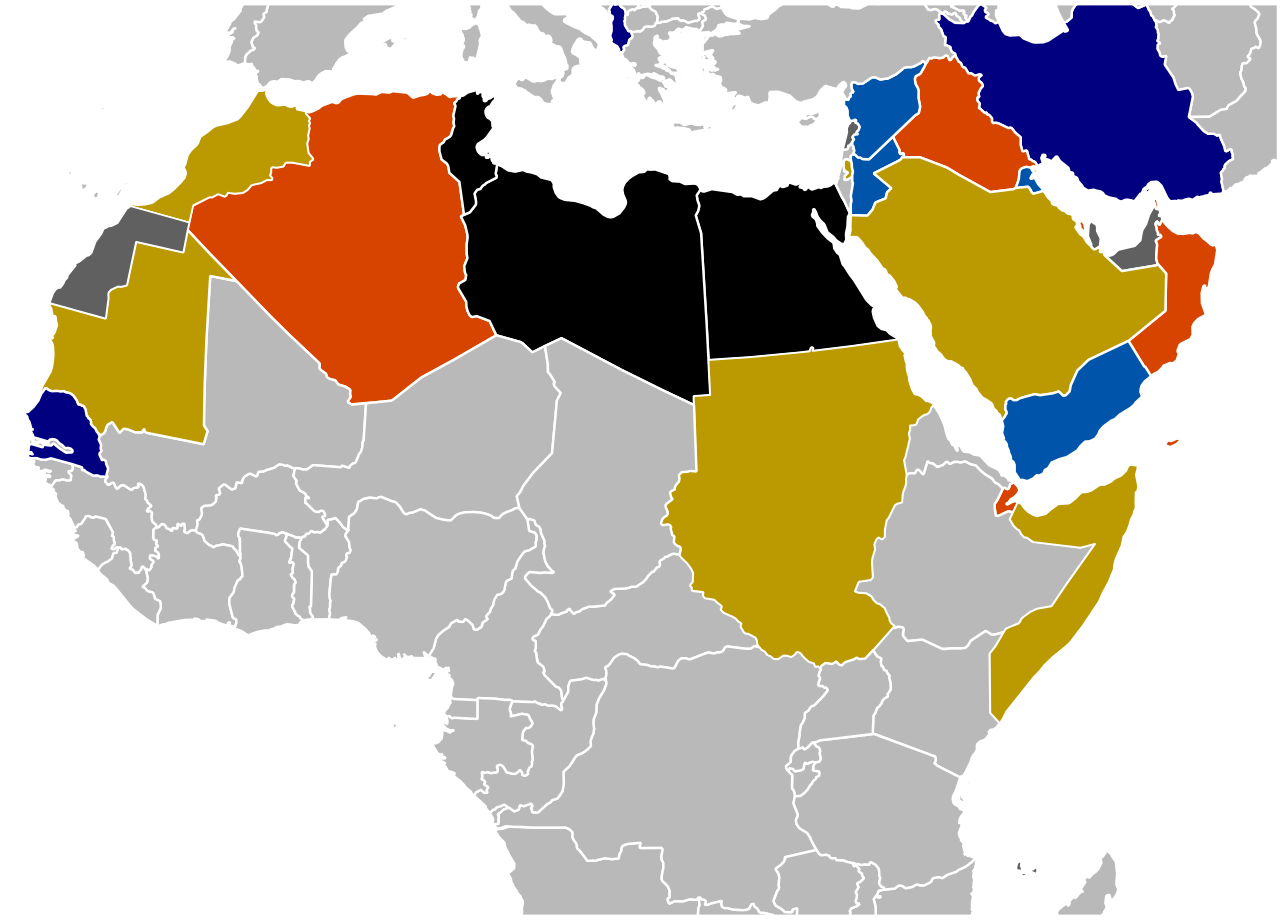
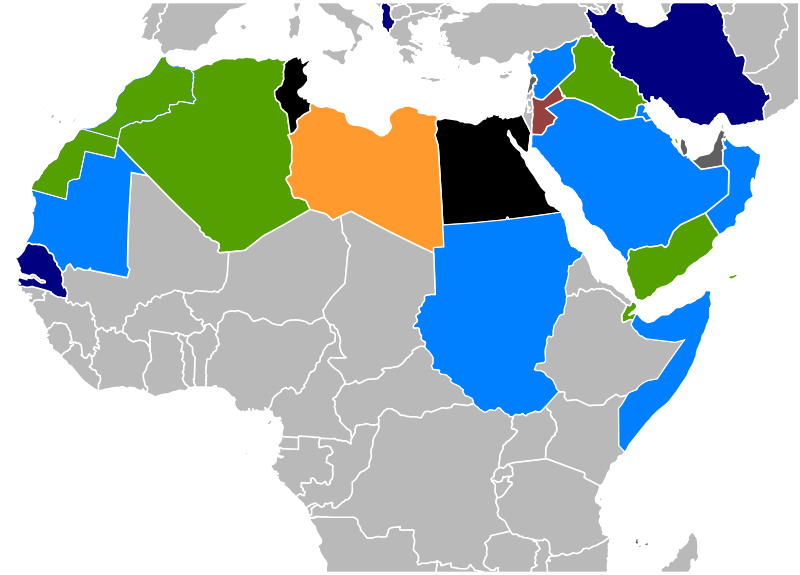
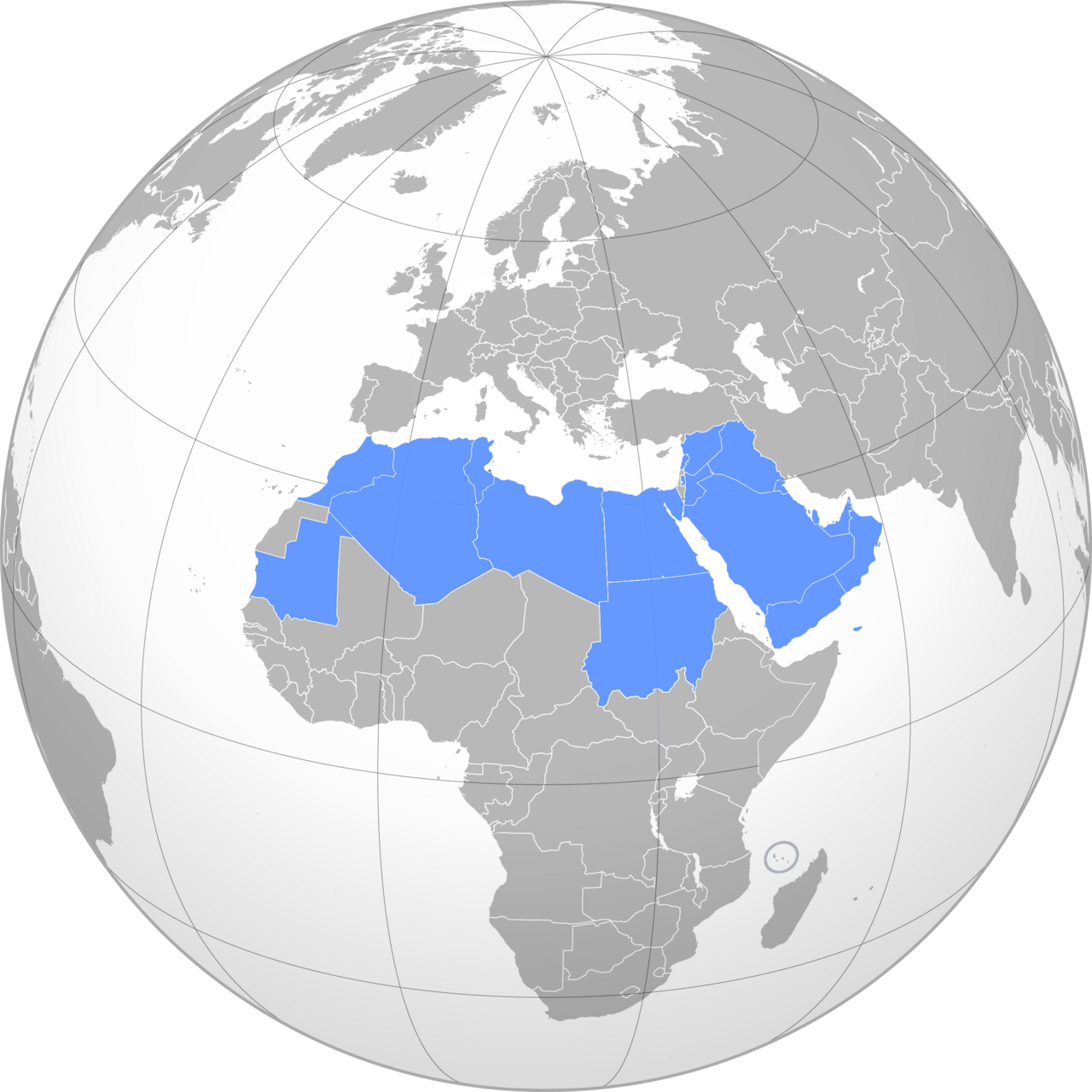
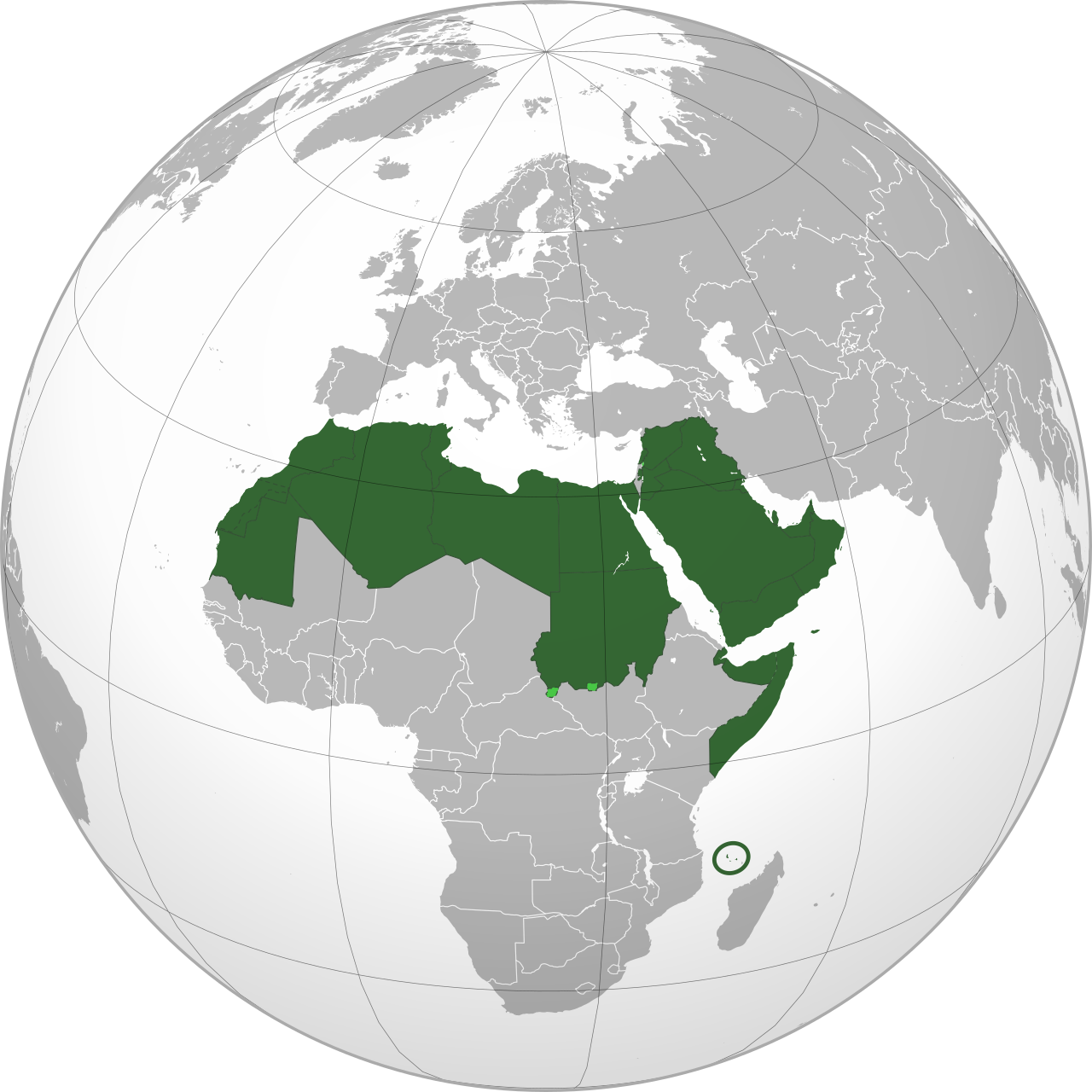
The Arab world comprises a large group of countries mainly located in West Asia and North Africa, stretching from the Atlantic Ocean to the Arabian Sea and from the Mediterranean Sea to the Indian Ocean. It is usually defined as the 22 members of the Arab League, which includes the Bantu-speaking Comoros and the Cushitic-speaking Djibouti and Somalia.
- languages
- Arabic (lingua franca); local vernaculars include Darija in the Maghreb and Aammiyya in the Mashreq
- major_ethnic_groups
- Arabs, Berbers, Kurds, Somalis, Nubians
- geographic_extent
- West Asia and North Africa, from Atlantic Ocean to Arabian Sea
Lore & Background
The Arab world historically originates from the Central Semitic groups of the northern Arabian Peninsula, Southern Levant, and Syrian Desert, including tribes such as the Nabataeans, Tanukhids, Salihids, and Ghassanids.
Reader's Guide
The Arab world's significance lies in its role as a cultural and political entity defined by the Arabic language and membership in the Arab League. The standard territorial definition of the Arab world includes all 22 Arab League members, though some states like Somalia, Djibouti, and Comoros have Arabic as an official language alongside other widely spoken languages. The linguistic and political denotation of 'Arab' generally dominates over genealogical considerations, and the region's vernaculars, while sharing most vocabulary with Standard Arabic, also borrow from Berber, French, Spanish, and Italian in the Maghreb.
Did You Know?
- The Arab world includes 22 members of the Arab League, but Malta, whose national language derives from Arabic, is not included.
- Chad, Eritrea, and Israel recognize Arabic as an official or working language but are not members of the Arab League.
- The eastern part of the Arab world is called the Mashriq, and the western part the Maghreb.
- Iran has about 1.5 million Arabic speakers, mainly in Ahvaz and other provinces.
Origins and Intellectual Evolution
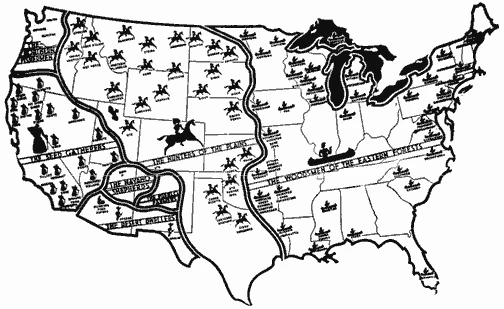
The idea of mapping human societies into distinct cultural zones did not emerge fully formed. Its earliest roots trace back to the late nineteenth century, when museum curators and ethnologists sought practical ways to organize their collections and exhibits. By pairing this curatorial impulse with taxonomic thinking, they laid the groundwork for what would become a formal analytical tool. Two American anthropologists, Clark Wissler and Alfred Kroeber, then pushed the concept forward, arguing that cultural areas reflected deep, longstanding divisions in human life. Although critics have long called these boundaries somewhat arbitrary, the practice of grouping communities into cultural areas has persisted as a standard method across the social sciences. In cultural geography, Carl O. Sauer and his colleagues at the Berkeley School reframed the idea, treating culture as an active agent shaping a natural landscape. Sauer's deterministic framing later drew criticism, prompting Yi-Fu Tuan and others to weave in phenomenological experience. This revision, now remembered as the cultural turn, gave rise to humanistic geography and broadened how scholars understand the relationship between people and place.
Typology: From Hearths to Spheres
Scholars have developed a rich vocabulary for describing how cultural influence radiates outward. Carl Sauer introduced the notion of a cultural hearth, a point of origin from which practices spread. Donald W. Meinig, writing about Mormon culture in 1970, preferred the term cultural core, while Fred Kniffen in 1965 and Henry Glassie in 1968 used source area when studying house and barn types. Glassie borrowed Meinig's language further, distinguishing a domain, where a culture is dominant, from a sphere, where it exerts influence without dominating. These spheres of influence can overlap or nest into concentric layers, with macrocultures enveloping smaller local ones. Boundaries shift depending on what aspect one examines: religion and folklore might draw one line, while dress, architecture, or language draws another. A separate typology identifies three broad forms: formal cultural regions marked by homogeneity across a contiguous area; functional regions united by shared political, social, or cultural roles; and perceptual or vernacular regions rooted in how people themselves perceive space, as illustrated by the Braj region of India, which feels like a spatial whole because of its shared religious and cultural associations.
Cultural Boundaries and Macro-Divisions
A cultural boundary marks the geographical line where one identifiable ethnic or ethnolinguistic culture gives way to another. Because language is a defining thread of any society's culture, a language border is automatically a cultural one, yet even within a single ethnolinguistic group, subtler lines can divide communities. In German-speaking Switzerland, the Brünig-Napf-Reuss line separates distinct subcultures; Germany's Weißwurstäquator draws a humorous but real cultural divide; and the Grote rivieren boundary distinguishes Dutch from Flemish cultural life. On a grander scale, European history reveals two major cultural fault lines. In Western Europe, the legacy of the Roman Empire remained dominant, creating a Latin cultural sphere, while in Germanic Europe that Roman heritage was significantly blended with local traditions. In the Balkans, the Jireček Line separates areas shaped primarily by the Western Roman Latin tradition from those shaped by the Eastern Roman Greek tradition. At the continental level, such macro-cultures are sometimes called worlds, spheres, or civilizations, with the Islamic world serving as a prominent example of this broader categorization.
Global Applications and Modern Resurgence
The framework of cultural areas finds expression across every inhabited continent and in every major language family. From the Maghreb and West Africa to Mesoamerica and the Caribbean, from the Sinosphere encompassing China Proper, the Korean Peninsula, and the Japanese archipelago to the Indian subcontinent and the Arabian Peninsula, scholars delineate regions where shared practices create recognizable cultural wholes. The Pacific islands are subdivided into Melanesia, Micronesia, and Polynesia, while Europe is parsed into Nordic, Iberian, Balkan, and other sub-regions. In Australia, the term cultural bloc was coined, likely by Ronald Berndt in 1959, to describe groups of linguistically and culturally similar Aboriginal peoples, such as the Western Desert bloc with its roughly forty dialects, the Noongar people of the southwest, the Bundjalung of northern New South Wales, and the Yolngu of Arnhem Land. Today, the concept is experiencing a renewed wave of both practical and theoretical interest. As social scientists turn their attention to the processes of cultural globalization, the old language of hearths, cores, and spheres is being reinvigorated to make sense of a world where cultural boundaries are simultaneously reinforced and blurred.
Gallery
More in Regions & Cultural Spheres 1-24
Elsewhere in the Regions & Cultural Spheres universe
Spotted an error? Know more?
This is a living reference — every entry is fact-audited, and reader corrections feed straight into our audit queue. Suggest an edit · See this site's audit record